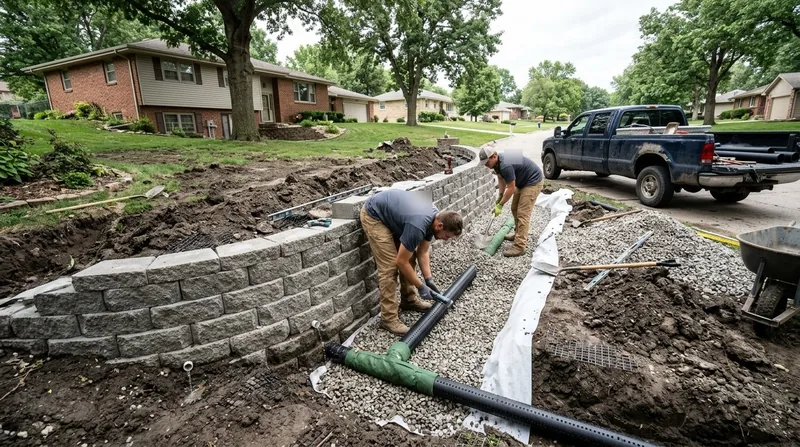




If you own a wall in Lincoln, Retaining Wall Drainage in Lincoln is the difference between a structure that holds for decades and one that bulges, leans, or topples after three or four spring storm cycles. This city sits on gently rolling glacial hills cut by Salt Creek, Antelope Creek, and Beal Slough, and most yards are flat or softly sloped with walkout grades in south and east Lincoln. That dense glacial clay till holds water like a bucket and swells when it is wet, so hydrostatic pressure builds up behind every wall that lacks a real drainage path. Hard freeze-thaw cycles and frost heave finish the job by pushing saturated soil against the back of the block. We install French drains, weep holes, gravel backfill, and waterproofing that move that water out and away, and we have fixed walls from the Near South to Havelock to the newer walkout subdivisions. If you want the whole picture on how walls are built, start with our retaining wall installation page, then come back here for the water side of the story.
Why Drainage Decides Whether a Lincoln Wall Survives
Walk any alley in University Place or a backyard in south Lincoln and you will find segmental block walls with no visible drain, and you will find the same failures over and over. Water trapped in clay till cannot percolate fast enough during a heavy spring thunderstorm, so it loads the wall from behind. Frost then drives that saturated soil outward, and the wall starts to lean before the first freeze is even over.
- Clay backfill holds water instead of releasing it, so pressure builds against the block face.
- Missing weep holes leave no exit path, and the wall carries the full hydrostatic load.
- Failed or clogged drain pipe lets silt in, and the system stops moving water within a few seasons.
- Frost heave lifts and shifts footings, which cracks mortar and opens joints in poured concrete and CMU walls.
- Downspouts and gutter discharges dumped behind a wall turn a small problem into a leaning wall repair.
We treat drainage as the structural core of the wall, not an accessory added at the end.
Key info: On a Havelock brick bungalow lot, we pulled out a 3-foot segmental block wall that had leaned 4 inches in two years. The backfill was pure clay with no gravel, no filter fabric, and no outlet. A French drain, clean gravel, and fabric behind the rebuilt wall fixed what no amount of bracing could.
The City of Lincoln publishes building permit guidance through its Development Services Center, and the local building department is the authority on what your project needs. Check lincoln.ne.gov for current thresholds and submittal requirements before you dig.
How We Build a Drainage System That Actually Works
We start by finding where the water comes from and where it can legally go. On most Lincoln lots that means daylighting the drain to a lower grade, a storm inlet, or a dry well sized for the soil. We excavate behind the wall, remove the saturated clay, and rebuild the water path in layers so silt stays out and flow stays open. Then we test it with a hose before anything gets buried.
- We inspect the wall face, footing, and backfill to find the failure mode and check for movement that means repair first.
- We excavate a trench behind the wall wide enough for gravel and the perforated pipe, and we keep the excavation clear of the footing.
- We line the trench with filter fabric so clay fines cannot migrate into the gravel and clog it.
- We set perforated PVC or corrugated pipe on a bed of washed gravel at the correct fall toward the outlet.
- We backfill with clean crushed stone, wrap the fabric over the top, and cap with soil.
- We core or set weep holes at the base of block and concrete walls so any residual water exits at the face.
- We waterproof the wall face where grade and soil conditions call for it, and we tie downspouts into the system.
- We run a flow test and show you the outlet before we backfill the last section.
Every wall gets a drainage plan matched to its height, soil, and the slope above it, because a 2-foot garden wall and a 6-foot walkout wall do not drain the same way.
Key info: A walkout lot near 68503 had a 5-foot block wall at the top of the slope and a downspout dumping right behind it. We tied the downspout into a French drain with a daylight outlet at the curb, and the wall stopped moving. That is typical of the drainage work we do across the area, and you can see the same approach on our retaining wall drainage in Lincoln 68503 page.
Drainage Approaches We Use on Lincoln Walls
Not every wall needs the same system. A poured concrete garage wall at grade in a 1950s ranch has different needs than a limestone garden wall in the Near South or a railroad tie wall holding a slope in a 1970s split-level yard. We match the approach to the wall type, the soil, and where the water can go.
| Approach | Description | Best for |
|---|---|---|
| French drain behind the wall | Perforated pipe in washed gravel, wrapped in filter fabric, with a daylighted outlet. | Most segmental block and timber walls with clay backfill. |
| Weep holes and face drainage | Cored or sleeved outlets at the base of the wall that release water at the face. | Poured concrete and CMU walls where a rear outlet is not possible. |
| Gravel backfill and filter fabric | Clean stone replaces clay behind the wall, with fabric keeping fines out. | Rebuilt and replacement walls, and any wall with swelling clay behind it. |
| Surface waterproofing | Membrane or coating on the wall face to keep water out of the structure. | Concrete and block walls below grade or against a walkout foundation. |
| Downspout and grade correction | Rerouting roof water and reshaping the slope so it drains away from the wall. | Walls that keep failing despite having a drain already. |
We combine these as needed, and we tell you plainly which ones your wall actually requires.
Retaining Wall Drainage Cost in Lincoln: What to Expect
Drainage work starts from $2,500 for a typical residential wall, and that figure covers excavation, pipe, gravel, fabric, and a proper outlet on a straightforward job. Real projects move up or down from there based on how much soil has to come out, how far the water has to travel to daylight, and whether the wall needs repair before drainage can help. A short wall with an easy outlet sits near the bottom of that range. A tall wall, a tight backyard with no machine access, or a system that has to tie into a storm inlet pushes it higher.
Access is the biggest wild card in Lincoln. A wall behind a Havelock bungalow with a narrow side yard means hand digging and more labor hours than the same wall on an open lot in Hickman. Saturated clay that has to be hauled off adds disposal cost. If the wall is already leaning, drainage alone will not fix it, and we will tell you that before you spend money on a drain that cannot save a failing structure.
Get two or three written estimates and compare what is actually included, not just the bottom line. A cheap quote that skips filter fabric or leaves the outlet short is not a bargain. Our full pricing overview lays out how we build quotes so you can compare apples to apples.
Retaining Wall Drainage Near Me: Choosing a Contractor Near Lincoln
When you search for retaining wall drainage near me, you will get a long list of names, and most of them will not be able to explain how water moves through clay till. Ask questions that separate the field pros from the sales pitch. A contractor who has worked Lincoln soil will talk about filter fabric, outlet elevation, and frost depth without being prompted.
- Confirm the company is fully insured, and ask for a certificate of insurance before work starts.
- Get multiple estimates in writing with the drainage components itemized, not lumped into one number.
- Ask for references from jobs in Lincoln and the surrounding towns, and call them.
- Ask who pulls the permit if your wall is above the local threshold or supports a driveway or structure.
- Check HOA rules and property-line setbacks before excavation, especially in newer subdivisions.
A contractor who hesitates on any of these is not the one you want behind your wall. Reach out through our contact page and we will walk your site and give you a straight answer.
Drainage and the Rest of the Wall System
Drainage is the first line of defense, but it works with the wall, not instead of it. If your wall is already bulging or has cracked, pair the drain work with leaning and collapsed wall repair so the structure gets corrected at the same time. On slopes above a creek bank or a walkout, drainage and slope stabilization go hand in hand. And if the wall is past saving, our retaining wall replacement service builds the new wall with the drainage designed in from the footing up. Call (531) 324-5728 and we will tell you which one your wall needs.
Retaining Wall Drainage in Lincoln: Pricing Guide
| Service | Price | Details |
|---|---|---|
| Basic French drain behind an existing wall | Starting at $2,500 | Includes excavation, perforated pipe, washed gravel, filter fabric, and a daylight outlet on an accessible wall. |
| Weep holes and face drainage for concrete or CMU | Starting at $2,500 | Coring, sleeving, and gravel packs at the base, priced by wall length and number of outlets. |
| Full drainage rebuild with waterproofing | Starting at $4,800 | Removes saturated clay, rebuilds the drain, and adds membrane waterproofing on walkout and below-grade walls. |
| Drainage tied to wall repair or replacement | On estimate | Needs an on-site look because structural correction and drainage are priced together, not separately. |
| Travel | Included | In Lincoln and surrounding areas, no separate call-out or mileage fee. |
| Estimate | Free | Response within 24h at (531) 324-5728, no obligation to book. |
Indicative pricing, the exact cost depends on square footage, finish, and site access. Free personalized estimate within 24h at (531) 324-5728.


