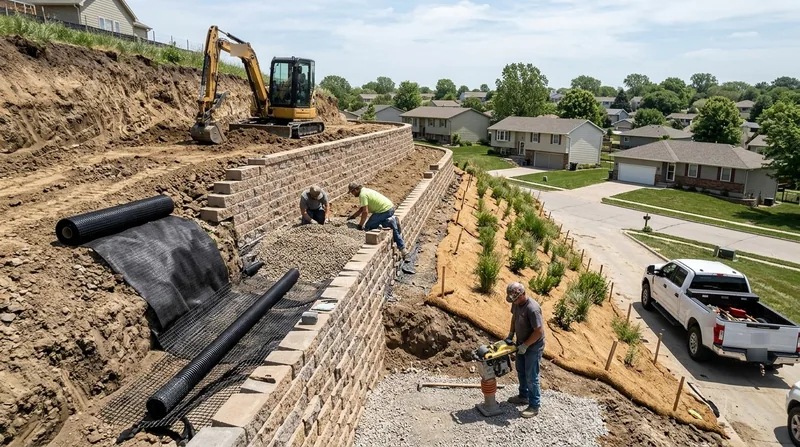




Lincoln sits on gently rolling glacial hills cut by Salt Creek, Antelope Creek, and Beal Slough, and that terrain decides where slope stabilization and erosion control in Lincoln actually matter. Most lots are flat or softly sloped, but walkout grades in south and east Lincoln, plus creek-bank yards along the drainageways, push water and soil downhill fast. Dense glacial clay till holds moisture and swells, hard freeze-thaw cycles heave the ground, and spring thunderstorms dump rain in short bursts. The result is rutted walks, undermined patios, and soil piling against foundations. We build terraced walls, geogrid reinforcement, and drainage that hold those slopes in place. If the grade is already sliding, start with retaining wall repair before the movement reaches the house.
Why Lincoln Slopes Fail: Clay Till, Frost Heave, and Spring Storms
Our soils are the problem. Glacial clay till drains slowly, expands when wet, and shrinks when dry, so a slope that looks stable in July can creep by March. Add frost heave to about 3 feet of frost depth and heavy spring rain, and you get the failure modes we see most: slumping walkout grades, creek-bank scour behind Havelock and University Place bungalows, and settled ground behind 1970s split-levels.
- Water ponds on the clay, saturates the slope, and pushes the toe outward until the bank slumps.
- Freeze-thaw cycles loosen block courses and open joints on segmental walls above walkout grades.
- Creek-bank yards along Antelope Creek and Beal Slough lose soil every spring unless the toe is protected.
- Downspouts and sump pumps discharge at the top of a slope and turn a small grade problem into a washout.
We read those signs on site and design the fix around the actual drainage pattern, not a generic slope template.
Key info: In south Lincoln walkout subdivisions, we routinely find 4 to 6 feet of clay till sitting over looser fill. That layer holds water against the foundation, so we terrace and drain the slope instead of just stacking block against it.
For permit thresholds and setback rules, verify with the City of Lincoln Building and Safety Department before any wall goes above roughly 4 feet: City of Lincoln, Nebraska.
How We Stabilize a Lincoln Slope, Step by Step
Every job starts with water. We walk the grade, check where runoff enters and leaves, and probe the soil before we price anything. On creek-bank lots near Hickman and Bennet, that often means protecting the toe first and terracing uphill. On in-town walkout lots, it means intercepting roof and surface water before it reaches the slope face.
- We survey the slope, mark utilities, and identify the water source feeding the movement.
- We excavate to stable soil and shape benches for terraced walls where the grade is steep.
- We install geogrid in lifts behind segmental block to tie the wall back into the hillside.
- We place drain rock, perforated pipe, and filter fabric so clay till cannot clog the drainage.
- We rebuild the surface with erosion control blanket, seed, or riprap on the steeper faces.
- We compact in lifts and check wall batter and drainage outlets before backfilling the top.
That sequence is what keeps a stabilized slope from moving again after the first hard freeze.
Key info: A Firth homeowner had a creek-bank yard losing about a foot of soil a year. We keyed a boulder toe into the bank, terraced two block walls above it, and routed the downspouts to a daylight outlet. Two springs later, the bank is holding.
When the slope sits behind an existing wall, the fix often overlaps with retaining wall drainage work, because the wall and the hillside share the same water.
Slope Stabilization Methods We Use Around Lincoln
Not every slope needs the same approach. A gently graded backyard in Crete may only need a low terrace and better drainage, while a steep creek bank in Seward needs toe protection and engineered reinforcement. We match the method to the grade, the soil, and what sits above it.
| Approach | Description | Best for |
|---|---|---|
| Terraced segmental block walls | Two or more stepped walls with geogrid tie-backs and drain rock behind each face. | Walkout grades and backyard slopes in south and east Lincoln. |
| Boulder and riprap toe protection | Keyed rock at the base of a bank to absorb water energy and stop undercutting. | Creek-bank yards along Salt Creek, Antelope Creek, and Beal Slough. |
| Geogrid reinforcement | Grid layers buried in compacted lifts to tie the wall back into stable soil. | Taller walls and slopes carrying a surcharge such as a driveway. |
| Surface drainage and erosion blanket | Swales, downspout outlets, and matting or seed to move water off the face. | Low to moderate slopes where water is the main driver. |
| Concrete or CMU retaining structures | Poured or block walls with footing and drainage for heavier loads. | Driveway and garage cuts where block alone will not carry the load. |
Slope Stabilization & Erosion Control Cost in Lincoln: What to Expect
We start every slope job with a free estimate because the range is wide. A low backyard terrace with drainage is a different project from a creek-bank stabilization with boulder toe protection and engineered geogrid. Height, access, soil depth, and whether the slope carries a driveway or structure all move the number.
Expect the price to climb with wall height, the amount of excavation, and the length of the slope face. Tight access behind a Havelock bungalow costs more to work than an open lot in Hickman. Creek-bank work adds toe protection and often riprap. If the slope sits above a structure, engineered drawings and a permit may be required, and that adds design cost. Get two or three estimates so you can compare scope, not just the bottom line. Our full pricing overview breaks down the ranges we see around Lincoln.
Finding a Slope Stabilization & Erosion Control Contractor Near Me in Lincoln
Slope work is easy to underbid and hard to fix later, so vet the contractor before you sign. Ask for proof of licensing and insurance, and confirm the certificate covers general liability and workers compensation. Get at least two or three written estimates that describe the drainage and reinforcement, not just the wall face. Call references from jobs like yours, and ask whether the slope has held through a spring thaw and a wet June.
Check permit requirements with the local building department before work starts. Walls above roughly 4 feet, or walls that support a driveway or structure, often need a permit and sometimes engineered drawings. If you live in an HOA, read the architectural rules first. Ready to talk through your slope? Contact us for a free estimate at (531) 324-5728. Fully insured.
Slope Stabilization & Erosion Control in Lincoln: Pricing Guide
| Service | Price | Details |
|---|---|---|
| Low terrace with drainage | Free estimate | Covers site walk, water source check, and a written scope for short slopes under 3 feet. |
| Terraced segmental block slope | Starting at $45 per square foot | Includes excavation, geogrid, drain rock, and pipe; height and access move the number. |
| Creek-bank stabilization | On estimate | Boulder toe, riprap, and terracing priced after we see bank height and water flow. |
| Engineered or permitted wall | On estimate | Walls above roughly 4 feet or carrying a surcharge need design review before pricing. |
| Travel | Included | In Lincoln and surrounding areas, no separate call-out or mileage fee. |
| Estimate | Free | Response within 24h at (531) 324-5728, no obligation to book. |
Indicative pricing, the exact cost depends on square footage, finish, and site access. Free personalized estimate within 24h at (531) 324-5728.


