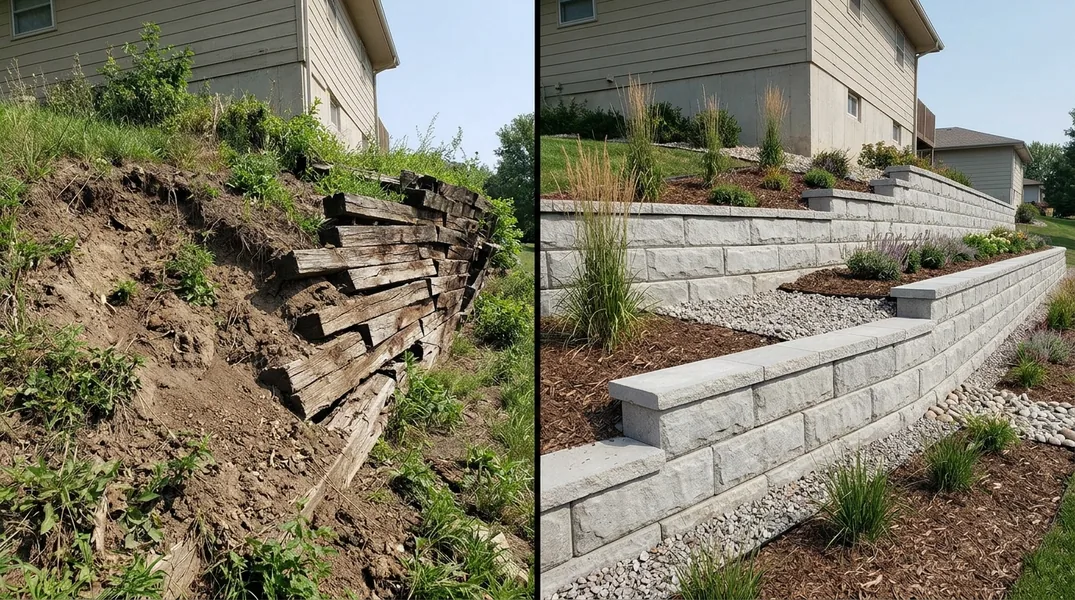
Why Lincoln's Soil and Winters Are Hard on Retaining Walls
If you live in Lincoln, you already know that the ground here is not like the sandy or rocky soils you might find in other parts of the country. Much of the area sits on expansive clay soil, which means it swells significantly when wet and shrinks when dry. That constant movement puts enormous pressure on any retaining wall, and it can cause poorly built walls to crack, lean, or even collapse within a few seasons. Understanding this is the first step toward choosing a material that will actually hold up.
On top of the soil challenge, Lincoln's freeze-thaw winters add another layer of stress. Water gets into small cracks and joints, freezes, expands, and then thaws, gradually widening those openings. Over time, this cycle can destroy a wall that was not designed with drainage and frost depth in mind. The best retaining wall materials for this region are those that can handle both the expansive clay and the seasonal freezing without losing structural integrity. That is why material selection matters just as much as the installation itself.
Concrete Retaining Walls: The Heavy-Duty Choice for Clay Soil
Concrete Retaining Walls are often the go-to option for homeowners dealing with significant grade changes and expansive clay. Poured concrete is extremely strong and can be engineered to resist the lateral pressure that clay exerts when it swells. Because it is a solid, monolithic structure, it does not shift piece by piece the way some modular systems can. For tall walls or walls holding back a steep slope, concrete is frequently the most reliable long-term solution.
That said, concrete is not maintenance-free. It needs proper reinforcement, adequate footing depth below the frost line, and a well-designed drainage system to prevent water from building up behind it. Without those details, even a thick concrete wall can crack under the combined pressure of clay and ice. If you are considering concrete, it is worth having a professional assess your site rather than assuming a standard design will work. A properly built concrete wall can last decades, but a poorly built one can fail surprisingly fast in this climate.
Block and Segmental Retaining Walls: Flexibility That Handles Movement
Retaining Wall Installation using block or segmental systems has become incredibly popular in Lincoln for good reason. A block retaining wall is built from interlocking units that fit together without mortar, and a segmental retaining wall uses similar modular blocks designed to flex slightly with ground movement. That flexibility is a major advantage in clay soil, because the wall can accommodate small shifts without cracking the way a rigid poured wall might.
These systems also drain well when installed with proper gravel backfill and geogrid reinforcement, which is critical for managing water pressure. The modular nature makes them easier to repair if a section is damaged, and they offer a wide range of styles and colors to match your home. For many residential projects in Hickman and surrounding communities, segmental block walls strike an excellent balance between durability, appearance, and budget. The key is ensuring the base is compacted correctly and the drainage is designed for the site, since even the best block will fail if installed on a poor foundation.
Boulder Retaining Walls: Natural Look, Serious Strength
Boulder retaining wall construction uses large, heavy stones stacked to hold back soil, and it is a favorite for homeowners who want a natural, rustic appearance. Because each boulder is massive, the wall relies on sheer weight and friction rather than mortar or interlocking pins. In clay soil, a well-placed boulder wall can be very effective at holding a slope, especially on lower walls where the pressure is manageable. The irregular shapes also allow water to move through the gaps, which helps relieve hydrostatic pressure.
However, boulder walls require careful placement and often need a gravel base and proper backfill to stay stable through freeze-thaw cycles. If the boulders are too small or stacked incorrectly, the wall can shift over time. They also work best on slopes that are not excessively tall, since very high boulder walls can become unstable without engineering. For the right setting, though, boulders offer a beautiful, long-lasting solution that blends naturally with Nebraska landscapes. A professional can help you determine whether your slope is a good candidate.
Retaining Wall Repair and Replacement: When to Call a Pro Near Me
Even a well-built wall can develop problems over time, especially in a climate that pushes and pulls at the structure every year. If you notice leaning, bulging, cracking, or water pooling behind your wall, it is worth getting an expert opinion before the issue gets worse. Retaining Wall Repair can often extend the life of a wall that is still fundamentally sound, addressing drainage issues or replacing a few damaged blocks. But if the foundation has failed or the wall is significantly out of alignment, repair may not be enough.
In those cases, Retaining Wall Replacement may be the safer and more cost-effective path forward. A failing wall can pose a real risk to your property, and patching a structural problem rarely works for long. If you are searching for retaining wall repair near me in the Lincoln area, it is best to have a professional inspect the wall in person. They can tell you whether a targeted fix will hold or whether a full rebuild with better materials and drainage is the smarter investment. Either way, addressing the problem early usually saves money and prevents bigger headaches down the road.
Retaining Wall Installation Cost in Lincoln: What to Budget
Homeowners often ask what a new wall will cost, and the honest answer is that it depends on several factors: wall height, length, material choice, site access, and how much excavation and drainage work is required. A short boulder wall on a gentle slope will cost far less than a tall engineered concrete wall holding back a steep grade. Material prices vary too, with segmental block typically landing in the middle range and poured concrete often costing more due to formwork and reinforcement. It is also worth budgeting for proper drainage, since skimping there is the most common cause of premature failure.
Because every yard is different, the best way to get an accurate number is to request a pricing consultation based on your specific site. A professional can walk your property, measure the slope, and recommend the material that makes the most sense for your soil and budget. For homeowners in Bennet and Firth, the same principles apply: get a site-specific assessment rather than relying on a generic per-square-foot estimate. To get started, you can free estimate or call Lincoln Retaining Wall at (531) 324-5728 to discuss your project and schedule a visit.
Looking for a professional retaining wall contractor in Lincoln? Lincoln Retaining Wall responds fast for all your retaining wall needs.
Get a Free QuoteOur services: Retaining Wall Installation · Retaining Wall Repair · Retaining Wall Replacement