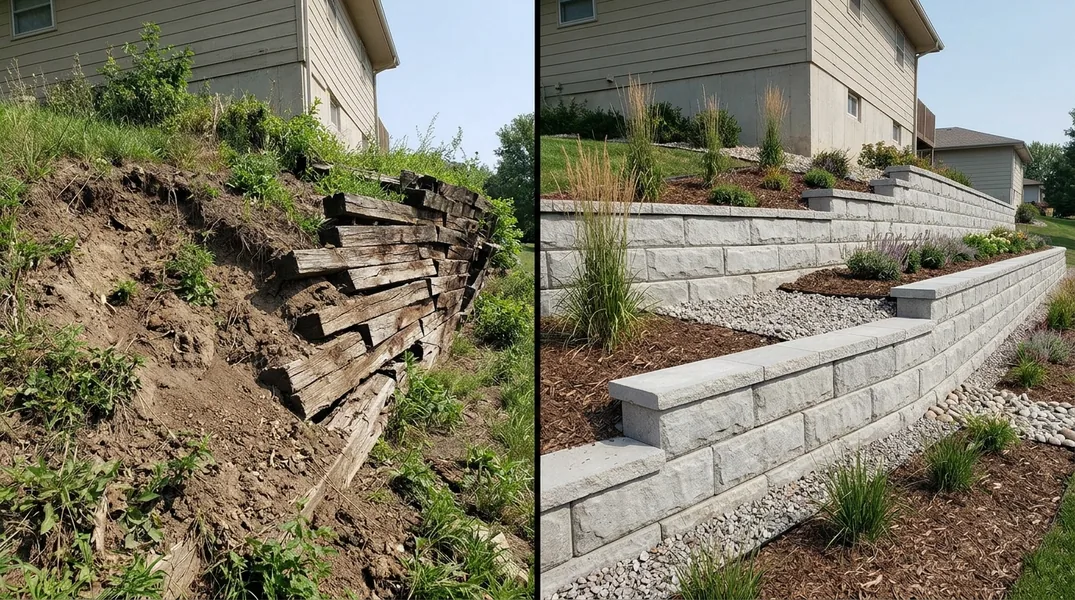
Why Lincoln's Spring Thaw Is the Most Dangerous Time for Retaining Walls
Every year, homeowners across Lincoln breathe a sigh of relief when winter ends. But for retaining walls, the real test begins as the ground thaws. During the freeze-thaw cycle, water that has seeped into the soil behind a wall freezes, expands, and then melts rapidly. This sudden release of moisture creates enormous pressure on the wall structure. If that water cannot escape, it builds up behind the wall and pushes outward with tremendous force. This is known as hydrostatic pressure, and it is the leading cause of retaining wall failure in our region.
Many homeowners do not realize that a retaining wall is only as strong as its drainage system. Even a well-built wall made of heavy stone or block can be toppled by water that has nowhere to go. In Lincoln, our clay-heavy soils make this problem especially severe. Clay absorbs water slowly and releases it even more slowly, meaning that during a spring thaw, the soil behind your wall can remain saturated for days or weeks. That prolonged saturation keeps hydrostatic pressure high and gives the wall no chance to recover. Understanding this cycle is the first step toward protecting your investment.
How Hydrostatic Pressure Quietly Destroys a Retaining Wall
Hydrostatic pressure is the force exerted by standing water. When water accumulates in the soil behind a retaining wall, it fills the voids between soil particles. As more water enters, the pressure increases and pushes against the back of the wall. Most retaining walls are designed to resist the lateral pressure of soil, but they are not designed to hold back a reservoir of water. When that reservoir forms, the wall begins to lean, crack, or bulge. You might notice horizontal cracks running along the face of the wall, or the top of the wall may start to pull away from the soil behind it. In severe cases, the entire wall can rotate forward and collapse.
The insidious part is that this damage often happens gradually. A wall might look fine on the surface while the soil behind it is slowly becoming a muddy, pressurized mess. By the time visible symptoms appear, the structural integrity may already be compromised. This is why Retaining Wall Repair is so often needed after a wet spring. Homeowners in Hickman and other nearby communities face the same challenge, because the soil conditions and weather patterns are similar throughout the area. The key takeaway is simple: if water cannot drain, pressure will build, and the wall will eventually fail.
The Role of a Retaining Wall French Drain in Preventing Failure
The most effective defense against hydrostatic pressure is a properly designed and installed retaining wall french drain. A french drain is a trench filled with gravel that contains a perforated pipe. It is placed behind the base of the wall and sometimes at higher levels within the backfill. The perforated pipe collects water from the surrounding soil and carries it away from the wall to a safe discharge point, such as a storm drain or a downhill area of the yard. When installed correctly, a french drain intercepts water before it can build up pressure and directs it away from the wall structure.
However, not all french drains are created equal. The pipe must be sloped correctly, the gravel must be the right size, and a filter fabric should be used to prevent soil from clogging the system. Many failing walls in Lincoln were built without any drainage at all, or with a drain that was poorly designed or has since become clogged with roots and sediment. If you are planning a new Retaining Wall Installation, make sure your contractor includes a robust drainage plan. If you already have a wall, it is worth having a professional inspect the drainage system before the next spring thaw. A functioning french drain is not a luxury; it is essential to the longevity of any retaining wall.
Warning Signs Your Retaining Wall Drainage Is Failing
Homeowners in Bennet and throughout the Lincoln area should watch for several warning signs that indicate drainage problems. One of the most common is water pooling at the base of the wall after rain or during snowmelt. If you see standing water or soggy soil near the wall, it means water is not being redirected away. Another sign is efflorescence, a white, powdery stain on the wall surface. This is salt deposited by water moving through the concrete or stone, and it often indicates that water is passing through the wall rather than draining behind it. You may also notice rust stains on the wall if the soil behind it contains iron and water is carrying it through.
Other symptoms include bulging or leaning sections of the wall, cracks that widen over time, and separation between the wall and the soil it retains. In some cases, the ground behind the wall may settle, creating a dip that collects water. If you observe any of these issues, do not wait. A small drainage problem can escalate quickly once the spring thaw begins. Contact a professional for an inspection and a free estimate on any needed repairs. Addressing drainage issues early is far less expensive than dealing with a collapsed wall later.
Retaining Wall Replacement Near Me: When Drainage Damage Is Beyond Repair
Sometimes the damage is too extensive for a simple repair. If a wall has suffered severe structural movement, multiple deep cracks, or has already partially collapsed, Retaining Wall Replacement may be the only safe option. This is especially true for older walls that were built without modern drainage standards. Replacing the wall allows you to install a proper drainage system from scratch, ensuring that the new structure will handle the spring thaw without issue. In many cases, replacing a failing wall with a new Concrete Retaining Wall is the most durable solution, as concrete walls can be engineered to withstand high hydrostatic pressure when paired with adequate drainage.
If you are searching for retaining wall replacement near me, it is important to choose a contractor who understands local soil conditions and the specific challenges of our spring thaw. A proper replacement involves excavating the old wall, assessing the soil, designing a drainage system that includes a french drain and proper backfill, and constructing the new wall to current standards. This is not a project for a general handyman. It requires specialized knowledge and experience. To discuss your options and get a clear picture of pricing, reach out to Lincoln Retaining Wall at (531) 324-5728. We serve Firth and the surrounding communities, and we are happy to provide a no-obligation assessment of your wall's condition.
Looking for a professional retaining wall contractor in Lincoln? Lincoln Retaining Wall responds fast for all your retaining wall needs.
Get a Free QuoteOur services: Retaining Wall Installation · Retaining Wall Repair · Retaining Wall Replacement