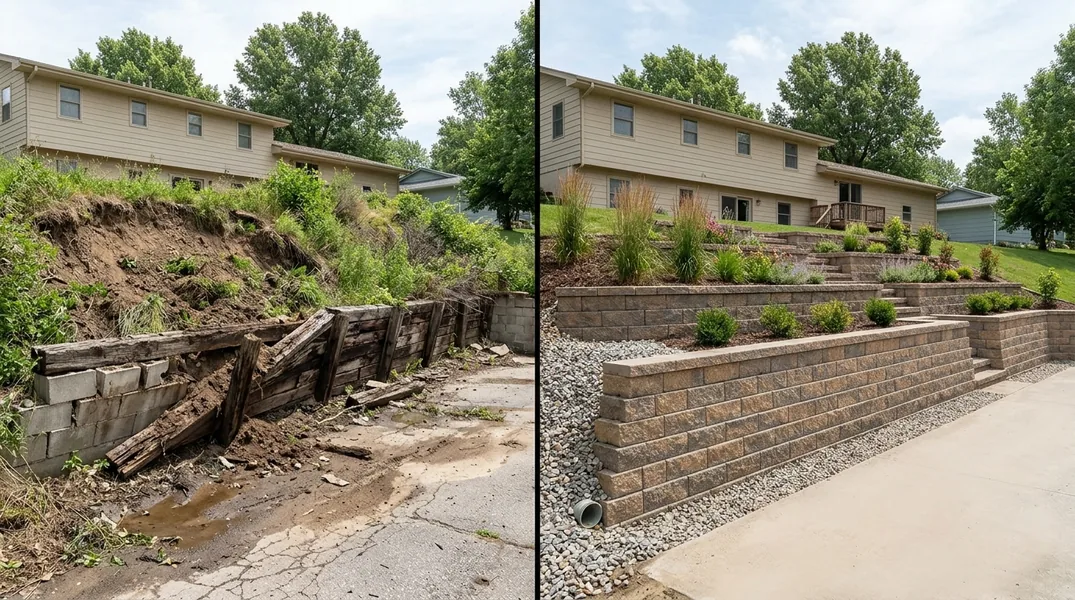
Why a Leaning Retaining Wall Is a Serious Warning Sign
A retaining wall that starts to lean is not just an eyesore. It is a structural warning that the forces behind the wall are winning. In Lincoln, our clay-heavy soils and freeze-thaw cycles put constant pressure on retaining walls, and a small tilt can quickly become a collapse that damages your landscaping, driveway, or foundation. The good news is that not every leaning wall needs to be torn out. The key is understanding what is causing the movement and how far it has progressed.
Most leaning walls fall into two categories: those that have settled or tilted slightly due to poor drainage or inadequate base preparation, and those that are actively failing because they were underbuilt for the load they carry. A wall that leans a few inches over many years may still be repairable with targeted Retaining Wall Repair. A wall that has moved suddenly, shows deep cracks, or is bulging outward is often a candidate for full Retaining Wall Replacement. Knowing the difference saves you money and protects your property.
Signs You Can Repair Instead of Replace
Repair is often viable when the wall is still mostly intact and the movement is limited. If the lean is minor and gradual, the wall blocks are not crumbling, and the drainage system can be improved, a contractor may be able to stabilize the wall, reset the base, and correct the drainage without tearing everything out. Cracked mortar joints or small fissures can sometimes be addressed with retaining wall crack repair, especially on concrete or block walls where the crack is cosmetic rather than structural. In these cases, repair is faster and less expensive than a full rebuild.
However, repair only works if the root cause is fixable. Poor drainage is the most common culprit in Lincoln, where water can saturate the soil behind a wall and create hydrostatic pressure that pushes it forward. If the wall was built without proper weep holes, gravel backfill, or a footing drain, simply patching the face of the wall will not stop the lean. A qualified contractor will evaluate the entire system, not just the visible damage. If the wall is less than a few years old and the lean is slight, repair is often the right call. If the wall is older and shows multiple failure points, replacement may be more cost-effective in the long run.
When Replacement Is the Smarter Choice
Replacement becomes the smarter choice when the wall is beyond stabilization. If the wall is bulging significantly, has large vertical cracks, or has already partially collapsed, repairing it is usually a temporary fix that will fail again. Walls that were built too tall for their base, lack proper reinforcement, or were never engineered for the soil conditions in Lincoln are prime candidates for replacement. In these cases, patching the visible damage does not address the underlying structural deficiency, and you will likely spend more money over time on repeated repairs than you would on a single, properly built replacement.
Replacement also makes sense when you want to upgrade materials or increase the wall's height or load capacity. Modern Concrete Retaining Walls are engineered to handle the freeze-thaw cycles and expansive soils common in Nebraska, and they can be designed with proper drainage from the start. If your current wall is failing because it was underbuilt, replacing it with a properly engineered system is the only way to guarantee long-term stability. A professional assessment will tell you whether repair or replacement is the better investment for your specific wall.
Retaining Wall Crack Repair: What It Can and Cannot Fix
Crack repair is one of the most misunderstood aspects of retaining wall maintenance. Not all cracks are equal. Hairline cracks in concrete or mortar can often be sealed to prevent water infiltration and further deterioration. These are typically cosmetic or minor maintenance issues. However, wide cracks, offset cracks, or cracks that run horizontally across the wall are signs of structural movement. Sealing these without addressing the cause is like putting a bandage on a broken bone. In many cases, retaining wall crack repair is only appropriate when the crack is stable and the wall is not actively moving.
If you see cracks combined with leaning, bulging, or soil settling behind the wall, the crack is a symptom of a larger problem. A contractor should evaluate the wall's drainage, base, and backfill before recommending crack repair. In some cases, crack repair can be part of a larger repair strategy that includes improving drainage and stabilizing the wall. In others, the crack is a sign that the wall needs to be replaced. Do not let a contractor simply fill the cracks without investigating why they appeared. That approach often leads to a bigger failure down the road.
Retaining Wall Repair Near Me: When to Call a Professional in Lincoln
If you are searching for retaining wall repair near me in Lincoln, you are probably already concerned about the safety of your wall. The right time to call a professional is as soon as you notice a lean, a crack, or any sign of movement. Waiting allows the problem to worsen, and a wall that could have been repaired might end up needing full replacement. A professional can assess the wall, identify the cause of the movement, and give you an honest recommendation about whether repair or replacement is the better path. They can also spot drainage issues that you might not notice, which are often the root cause of wall failure.
At Lincoln Retaining Wall, we specialize in evaluating and fixing leaning walls in Lincoln and the surrounding communities. We understand the local soil conditions and building codes, and we can help you decide whether repair or replacement makes sense for your budget and long-term goals. If you are unsure about the condition of your wall, do not guess. Call us at (531) 324-5728 or request a free estimate to get a professional opinion. We will walk you through your options and help you protect your property.
Retaining Wall Replacement Cost in Lincoln: What to Budget
If replacement is the right choice, you will want to understand the pricing involved. Retaining wall replacement cost in Lincoln varies based on the height and length of the wall, the materials you choose, and the site conditions. A simple, short wall might cost significantly less than a tall, engineered wall that requires excavation, new drainage, and reinforced footings. Concrete walls tend to cost more upfront than block walls, but they often last longer and require less maintenance, which can save you money over time. The best way to get an accurate number is to have a contractor evaluate your specific site and provide a detailed quote.
Do not choose a contractor based on the lowest bid alone. A cheap replacement that skips proper drainage or base preparation will fail again, and you will end up paying twice. Look for a contractor who explains the importance of drainage, uses quality materials, and provides a clear written estimate. If you are comparing quotes, make sure they include the same scope of work. At Lincoln Retaining Wall, we provide transparent pricing and detailed proposals so you know exactly what you are paying for. Contact us today to schedule your assessment and get a clear picture of what your replacement will cost.
Looking for a professional retaining wall contractor in Lincoln? Lincoln Retaining Wall responds fast for all your retaining wall needs.
Get a Free QuoteOur services: Retaining Wall Installation · Retaining Wall Repair · Retaining Wall Replacement